Garage parks.
The most down-to-earth form of self storage: ground-level units where you drive right up to the door with your car or van. One distinction is often overlooked: in Germany, a garage for parking is legally something different from a garage for storage.
Indicative values, project-dependent.
Photo: Troy Mortier / Unsplash
The principle
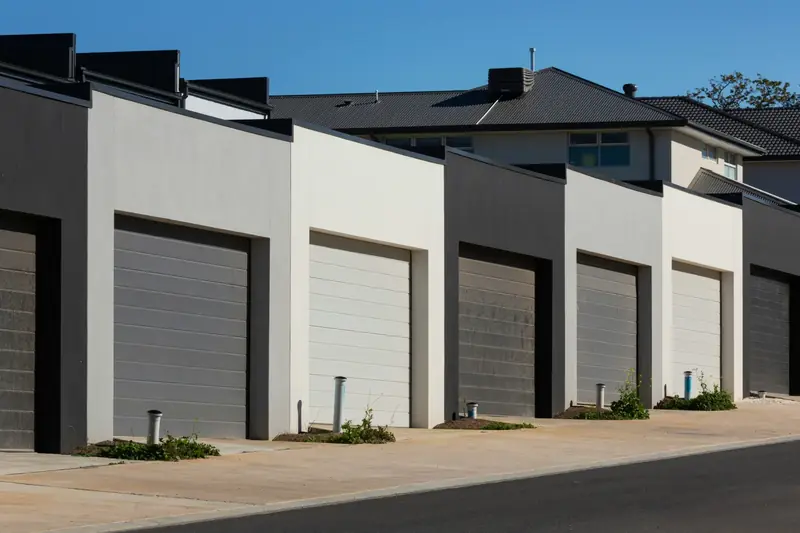
A garage park consists of rows of single-storey units, each with its own door, served by wide driveways. Tenants drive up, unload and lock up, with no corridor, lift or trolley. That is what makes garages the oldest form of self storage in Germany.
Modern garage parks go beyond the classic rental garage: larger units with power and lighting, online rental, electronic access and CCTV. This blurs the line with drive-up facilities and small business units.
Vehicle garage or storage garage
The term “garage park” covers two types that look similar in everyday use but differ significantly in legal and economic terms:
Vehicle garages
Rental garages and garage courts of around 15–20 m², permitted as garages. They are for parking vehicles (car, motorbike, trailer) plus accessories such as tyres. Household goods, furniture or stock generally do not belong there.
Storage & hobby garages
Large-format units, often 20–60 m² and taller, with power, lighting and wide doors. They are planned and permitted as storage space from the outset, so vehicles, household goods, seasonal items, materials and tools can all be kept together.
Two common variants can be combined with either type:
- Motorhome, caravan and boat storage: covered or enclosed. The number of leisure vehicles has grown strongly, and suitable parking is scarce in many places.
- Business garages: units for trades, caretaking services, online retail and delivery services, with vehicle, materials and tools in one place.
What may go in a garage?
A unit with a building permit as a garage is bound to its purpose: parking motor vehicles. Using it permanently as storage space changes its use, and such a change of use requires a permit. This applies to owners and tenants alike.
- Administrative Court of Cologne (judgment of 26 June 2025, ref. 8 K 6166/24): a garage permitted as a parking space is not additional storage space but part of the approved parking concept. Using it for storage without a permit is not allowed.
- Local Court of Hamburg-St. Georg (judgment of 28 July 2023, ref. 980a C 10/23 WEG): underground parking spaces may not be used regularly as storage, for example with cabinets or boxes.
- State garage regulations: they additionally limit which flammable materials may be kept in garages outside vehicles, in Bavaria for example section 17(4) of the Garage and Parking Regulation (GaStellV).
Sources (German): IVD: a garage is not a storage room · Section 17 GaStellV Bavaria · Haus & Grund RLP on misuse of garages. Rules differ by federal state and case. Not legal advice.
Construction & technology
Precast concrete garages
Factory-built single or row garages are lifted into place by crane. Very robust and low-maintenance, quick to install, but limited in size and height and hard to modify later. Typical of vehicle garage courts.
Steel and system halls
Steel-frame halls with sandwich panels allow larger spans, taller doors and flexible unit sizes. Partitions can be moved later, making the facility more adaptable. The usual construction for new storage and hobby garages.
Doors, driveways & surfaces
Sectional or roller doors, electric if required, define comfort and appearance. Driveways should be generous so that vans and trailers can manoeuvre. Paved, well-drained surfaces are essential.
Access & security
Fencing, gate access by code or app, lighting and CCTV. For valuable vehicles, tenants also expect intruder alarms per unit or an insurance solution.
Permits
Garage parks are structures and generally require a building permit. The application must already state which use is intended: garage for vehicles or storage space. The local development plan, the state building code and the state garage and parking regulations are decisive.
- Commercial and industrial zones are usually suitable; mixed-use zones depend on the individual case
- Setbacks, fire safety and escape routes under the state building code, and for vehicle garages under the garage regulation
- Sealed surfaces and rainwater: a drainage concept, possibly infiltration or retention
- Usage rules in the rental contract: no living, no hazardous substances, clear rules on workshop use
Location requirements
- Edge of town, business park or outskirts with quick access to residential areas
- Catchment with many households without their own garage and with leisure vehicles
- Good access for large vehicles, no narrow village through-roads
- Sites from around 3,000 m²; larger plots allow a more economical mix
- Visibility from the road helps but matters less than for indoor sites
Costs & economics
Investment per lettable square metre is usually well below that of an indoor facility: no multiple storeys, no climate control, little building services. In return, land required per square metre of lettable area is higher and the achievable rent per m² is lower.
The economic appeal lies in stability: long tenancies, low churn and very lean operations. Garage parks therefore behave more like a classic real estate investment than a service business.
Existing sites & garage courts
Many towns, particularly in eastern Germany, have large garage courts from the 1960s to 1980s. They offer potential for acquisition, refurbishment or redevelopment, but are often demanding:
- Sometimes separate ownership of land and garages, existing usage agreements
- Refurbishment needs for roofs, doors, driveways and drainage
- Possible contamination and missing permit documents
Anyone developing such sites should carefully check the legal position, building fabric and tenant structure, and bear in mind that a garage court is permitted as vehicle garages: marketing it as storage space requires a change of use. Done well, the result is a well-located site with established demand.
Who a garage park suits
A good fit if …
- open land at the edge of town is available
- stable, long-term income matters more than pricing dynamics
- operations should stay as lean as possible
Less suitable if …
- only a small, expensive inner-city plot is available
- the highest rent per m² is the priority
- the facility is expected to be heavily remodelled later